AI Is Becoming SI: What Does Super Intelligence Actually Mean?
What Executives & Technical Leaders Need to Know
- 01A Policy Rebranding, Not an Algorithmic Breakthrough: Executive Order 14434 directs U.S. federal agencies to use "Super Intelligence" (SI) in official non-statutory communications, but directly links its legal meaning to the existing statutory definition of AI in 15 U.S.C. 9401.
- 02Commercial vs. State Divergence: While high-profile tech leaders like Elon Musk renamed operations (e.g., SpaceXSI), major states like California explicitly reaffirmed their commitment to the traditional term "Artificial Intelligence."
- 03The Capability Over Acronym Rule: Businesses should not assume a system branded "SI" is superior to one branded "AI." Evaluate actual data connectivity, tool integration, multi-step agentic workflows, reliability, and human-in-the-loop controls.
- 04Maintain Customer-Centric SEO Language: For marketing, sales, and GTM, keep using established search terms ("AI automation," "AI agents," "AI marketing") that customers actively search for, rather than risking confusion with premature rebrands.
Artificial Intelligence, or AI, has been the standard global term for intelligent computer systems for decades. In September 2026, however, the U.S. federal government officially began using a different term: Super Intelligence, or SI.
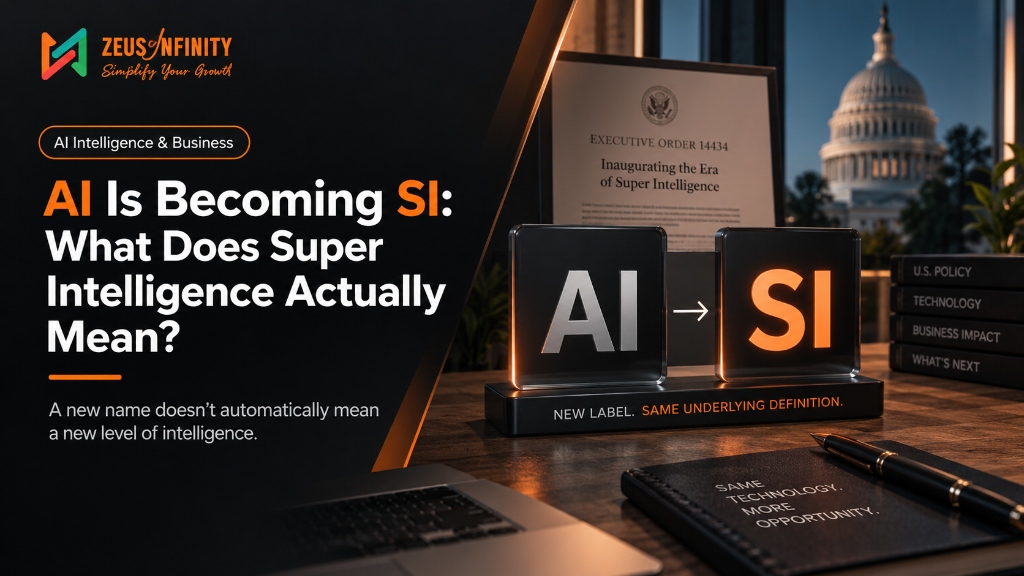
President Donald Trump signed Executive Order 14434, titled Inaugurating the Era of Super Intelligence, on 29 September 2026. The order directs U.S. executive departments and agencies to use “Super Intelligence” and “SI” instead of “Artificial Intelligence” and “AI” in applicable official communications and other non-statutory documents.
The terminology has already begun rippling across private industry and state governments. Elon Musk announced that SpaceX would rename its AI operations to SpaceXSI. Conversely, California issued an executive order affirming its commitment to the established term “Artificial Intelligence,” setting up a visible terminology divergence across governments and tech ecosystems.
What Does the Executive Order Actually Do?
Executive Order 14434 is an official directive aimed at modernizing federal language around machine intelligence. The key provisions include:
1. Federal Agency Language Update
Executive branch departments are instructed to transition official non-statutory communications, internal policy memos, and agency materials to "Super Intelligence."
2. 60-Day Legislative Proposal
Directs the federal administration to develop proposed statutory language defining Super Intelligence for future Congressional legislation within 60 days.
3. Statutory Mapping
Explicitly states that until new legislation passes, SI legally refers to the definition of artificial intelligence found in 15 U.S.C. 9401(3).
4. OMB Implementation Guidance
The Office of Management and Budget (OMB) will publish operational guidelines for federal procurement and administrative compliance.
The Terminology Spectrum: AI vs. Agentic AI vs. AGI vs. ASI vs. SI
The conversation around machine intelligence has accumulated multiple overlapping acronyms. To avoid marketing confusion, here is how each term is technically and commercially understood:
| Category | Standard Definition | Current Status | Primary Use Case |
|---|---|---|---|
| AI (Artificial Intelligence) | Broad term for computer systems performing cognitive tasks like analysis, reasoning, and content generation. | Active / Global Standard | LLMs, classification, recommendation engines, computer vision. |
| Agentic AI / AI Agents | Systems that execute multi-step plans, use external APIs/tools, and operate semi-autonomously within boundaries. | Production Enterprise | Automated outbound SDRs, code refactoring, pipeline monitoring. |
| AGI (Artificial General Intelligence) | Hypothetical intelligence matching human-level cognitive flexibility across virtually all economically valuable work. | Theoretical / R&D | Broad cross-domain reasoning and autonomous discovery. |
| ASI (Artificial Superintelligence) | Hypothetical machine intelligence vastly exceeding the cognitive performance of the smartest human minds. | Theoretical Horizon | Breakthrough scientific synthesis and planetary-scale systems. |
| SI (Super Intelligence) | U.S. Federal Administrative Designation: Officially adopted term for existing AI and emerging systems under Executive Order 14434. | U.S. Federal Standard | Federal communications, public sector contracts, branding (SpaceXSI). |
The 8-Point Business Capability Framework
Rather than debating whether a vendor's product uses "AI," "Agentic AI," or "SI" in its marketing pitch, technical buyers and founders should evaluate systems across eight practical capability dimensions:
Can it connect to internal company data?
Determine whether the model is restricted to prompt context or can securely query data lakes (Snowflake, BigQuery), CRMs, ERPs, and document repositories under granular ACLs.
How deep is its multi-step logic?
Test how the system decomposes multi-layered challenges across research, code generation, financial modeling, and root-cause analysis without drifting.
Which APIs and tools can it operate?
A text-generating AI is fundamentally different from an agent equipped with Model Context Protocol (MCP) servers, terminal shells, browsers, and API access.
Does it advise, or does it execute?
Clarify whether the system merely suggests copy and recommendations or has authorized write/execute permissions to send emails, deploy code, or update databases.
How often does it require user prompts?
Measure the system's ability to plan, self-correct, and execute long-horizon workflows without stalling on every intermediate step.
What is the verifiable accuracy rate?
A feature that hallucinates 10% of the time cannot be embedded into customer-facing operations or financial transaction pipelines.
What happens when edge cases fail?
Ensure automated rollback triggers, deterministic validator scripts, and rate-limiting safeguards are active before giving agents autonomy.
Where is human sign-off required?
The highest-ROI automation systems do not eliminate human judgment—they position human experts as governors who review high-stakes actions.
The True Capability Progression
The debate over naming conventions should not distract leaders from the rapid compounding of real-world AI capabilities over the past 36 months:
Drafting, summarization, conversational chat
Data plugins, SQL query synthesis, visual charts
Web search, code interpreters, MCP APIs
Autonomous outbound, CRM sync, live audits
This progression is cumulative and continuous. The technology did not transform into a fundamentally new paradigm on September 29 solely because of a federal designation.
Should Businesses Rebrand to "SI"?
For commercial businesses, agencies, and SaaS companies operating outside federal contracting, there is currently no reason to replace "AI" with "SI" in customer-facing materials.
At ZeusInfinity, our position is clear: speak the language of your customer while building the highest-leverage systems under the hood.
Conclusion: The Bottom Line for Leaders
The shift from AI to SI in federal policy is a notable development in regulatory language and governmental signaling, but it is not evidence of an overnight technical leap.
Executive Order 14434 establishes an administrative preference for the term "Super Intelligence," yet grounds its legal meaning in the existing definition of AI. For businesses, the competitive advantage lies in building high-reliability agentic workflows that compound pipeline and revenue—regardless of which acronym dominates headlines.
Frequently Asked Questions (FAQ)
What is the difference between AI and SI?
Currently, the shift from AI to SI in the U.S. federal government is a terminology change established by Executive Order 14434. The order explicitly maps "Super Intelligence" (SI) to the existing federal statutory definition of artificial intelligence (15 U.S.C. 9401) while a proposed legislative definition is drafted. It does not represent an overnight technological shift.
What is Executive Order 14434?
Signed on September 29, 2026, Executive Order 14434 ("Inaugurating the Era of Super Intelligence") directs U.S. executive departments and agencies to transition to using "Super Intelligence" and "SI" in place of "Artificial Intelligence" and "AI" in official communications and non-statutory materials.
Should private businesses start rebranding AI to SI?
For most commercial businesses, there is no immediate reason to rebrand. Customers and search engines actively search for established terms like "AI automation", "AI marketing", and "AI agents". Abandoning recognized AI terminology prematurely can create market confusion and harm organic search visibility.