Google Search Console Now Tracks Social & Video SEO (2026)
If you've spent any time on SEO or digital marketing, you know Google Search Console as the tool that shows how your website performs on Google Search. Clicks, impressions, rankings, all website data, all the time.
That changed on July 7, 2026.
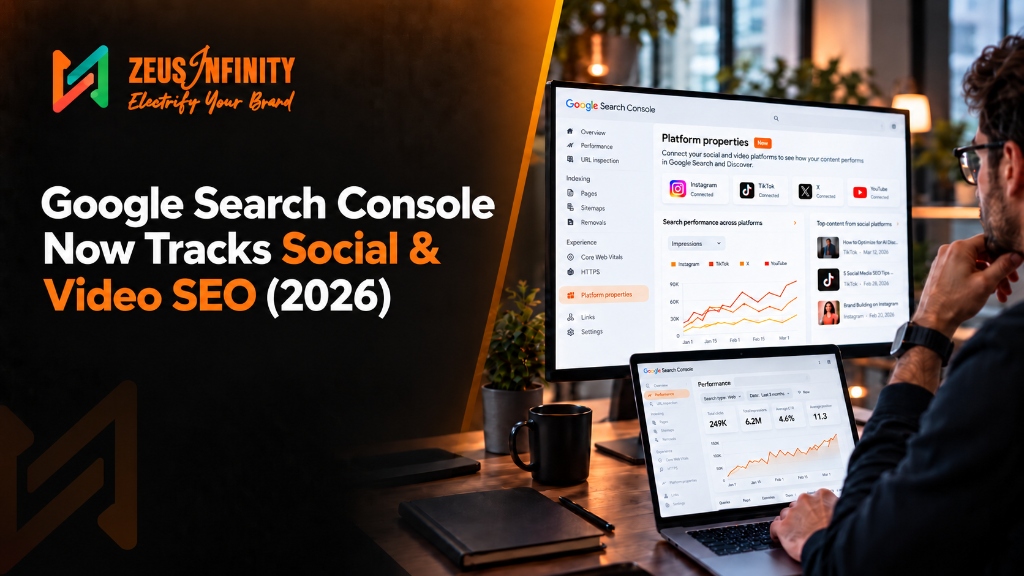
Google quietly rolled out a feature called Platform Properties, and for the first time ever, it lets you connect Instagram, TikTok, X, and YouTube accounts directly to Search Console, even if you don't own a website at all.
In this blog, we'll break down exactly what this update is, why Google built it, how to set it up, and what it means for your social media SEO and video SEO strategy going forward.
Table of Contents
- What Are Google Search Console Platform Properties?
- Why Google Launched This Social Media SEO Update
- Which Platforms Are Supported Right Now
- What Data You Can Actually See
- Step-by-Step: How to Set Up a Platform Property
- Why This Matters for Social Media SEO and Video SEO
- What This Means for Your Digital Marketing Strategy
- Frequently Asked Questions
What Are Google Search Console Platform Properties?
Platform Properties are a brand-new type of property inside Google Search Console, Google's free tool for monitoring how content performs on Search.
Until now, Search Console recognized only two kinds of properties: a full website domain, or a specific URL prefix. Both required you to prove ownership of a site you controlled.
Platform Properties break that rule. Instead of verifying a domain, you authorize Google to connect directly to a social or video account you own. Once connected, Search Console shows you how that account's individual posts and videos are being discovered through Google Search and Google Discover, the same way it already tracks website pages.
In simple terms: your Instagram reel or YouTube video can now show up in the same kind of performance report as your website's homepage.
Why Google Launched This Social Media SEO Update
This update didn't come out of nowhere. It's part of a broader pattern Google has been building over the past several months:
- December 2025: Google tested a "social channels" experiment inside Search Console Insights
- June 2026: Google introduced Search Generative AI performance reports and launched "Search profiles" (public-facing pages showcasing a creator's content)
- July 2026: Platform Properties officially launches, extending full Search Console reporting to social and video accounts
Taken together, this shows Google is deliberately reshaping Search Console to reflect how people actually find content today, not just through websites, but through short-form video, social posts, and AI-powered search experiences.
Google's own stated goal is straightforward: give creators and brands, including those without a traditional website, a single consolidated view of how their content is being discovered on Search.
Which Platforms Are Supported Right Now
At launch, Platform Properties support four major platforms:
- TikTok
- X (formerly Twitter)
- YouTube
Google has confirmed the rollout will happen gradually over the coming weeks, so not every account will see the option immediately. It's also worth noting this is separate from "Search profiles," which are public creator pages, Platform Properties is purely an internal analytics feature, not something your audience sees.
What Data You Can Actually See
Once a Platform Property is verified, you get access to reporting that will look familiar if you've ever used Search Console for a website:
- Total clicks and impressions for your social and video posts, sourced specifically from Google Search and Discover
- Post-level and query-level filtering, so you can see exactly which pieces of content and which search terms are driving traffic
- Export options, so the data can be pulled into your own dashboards or reporting tools alongside your website analytics
This means you can finally answer a question that's been almost impossible to track until now: "Is this Reel or YouTube video actually being found through Google Search, and if so, what did people type in to find it?"
Step-by-Step: How to Set Up a Platform Property
Setting it up takes just a few minutes:
- Open Google Search Console.
- Go to the property selector dropdown at the top of the page, or head to the verification page directly.
- Click "Add Property."
- Select the platform you want to connect, Instagram, TikTok, X, or YouTube.
- Follow the on-screen steps to securely authorize the connection to your account.
- Once verified, your Performance report will begin populating with search data (allow some time, as rollout is gradual).
No coding, no DNS records, no file uploads, just account authorization, similar to logging into an app.
Why This Matters for Social Media SEO and Video SEO
For years, SEO and social media were treated as two separate departments with two separate goals. SEO teams chased keyword rankings on the website. Social teams chased likes, shares, and watch time inside the app.
Platform Properties effectively erase that line.
Here's why that matters:
- Social posts are now measurable search assets, not just short-lived engagement content. A well-optimized video or caption can continue earning visibility on Google long after it stops trending on the platform itself.
- Search intent data becomes available for social content. You can now see the exact phrases people use on Google to find your posts, often very different from how people talk inside the app itself, and use that to improve titles, captions, and video descriptions.
- Creators without a website are no longer invisible to SEO. A business or creator relying entirely on Instagram or YouTube can now get genuine search performance insight, something that was previously exclusive to website owners.
This is a meaningful shift in how search visibility is measured, and it signals that Google is treating cross-platform content as one connected ecosystem rather than isolated channels.
What This Means for Your Digital Marketing Strategy
If your current marketing plan treats your website and your social media as two separate efforts, this update is a good moment to rethink that.
A few practical shifts worth considering:
- Audit your social content the way you'd audit a website page. Are your captions, titles, and video descriptions written for a person searching Google, not just someone scrolling a feed?
- Use social performance as a content signal. When a TikTok or Reel earns strong search impressions for a specific topic, that's a strong hint the topic deserves a full blog post, landing page, or service page too.
- Stop siloing your teams. Whoever manages your social content is now, whether the job title changes or not, contributing directly to your SEO performance.
This is exactly why a 360-degree digital marketing approach, website, SEO, and social working from one strategy, consistently outperforms a website-only or social-only effort. Google's own product roadmap is now built around that same idea.
Ready to Turn This Into Real Rankings? Work With ZeusInfinity Services
Reading about an update like this is one thing. Actually turning it into more traffic, more visibility, and more leads for your business is a different job altogether, and it's the job we specialize in.
At ZeusInfinity Services, we don't just track SEO updates like this one, we build your entire digital presence around them, before your competitors even notice they happened.
Here's how we help businesses like yours rank higher and get found everywhere Google is looking:
- Website SEO - technical audits, on-page optimization, and content strategy built to rank on Google Search
- Social Media & Video Optimization - making sure your Instagram, YouTube, and TikTok content is written and structured to perform in search, not just in the feed
- 360-Degree Digital Marketing - website, SEO, social, and paid campaigns working from one connected strategy, not scattered efforts
- Ongoing Performance Reporting - clear, easy-to-understand reports so you always know what's working and why
Google itself is now telling us that a website-only approach isn't enough. If you're ready to make sure your business is visible everywhere your customers are searching, not just on your homepage, we'd love to help.
Talk to ZeusInfinity Services today and let's build a search strategy that actually keeps up with where Google is headed.
Frequently Asked Questions
1. What are Google Search Console Platform Properties?
Platform Properties are a new Search Console feature that lets you connect Instagram, TikTok, X, or YouTube accounts to see how your posts perform in Google Search and Discover, similar to how website performance is already tracked.
2. Do I need a website to use Platform Properties?
No. This feature was specifically designed for creators and businesses who may not have a traditional website but still want visibility into their Google Search performance.
3. Is this the same as Google Search profiles?
No. Search profiles are public-facing pages that showcase a creator's content to their audience. Platform Properties are private, internal analytics, only visible to the account owner inside Search Console.
4. Which platforms are supported?
At launch: Instagram, TikTok, X, and YouTube. Google has not confirmed additional platforms yet.
5. Is this feature available to everyone right now?
Google has stated the rollout is gradual and will happen over several weeks, so availability may vary by account.
6. Does this affect how I should write social media captions?
Yes. Since your captions and video titles can now influence Google Search visibility, it's worth writing them with real search intent in mind, not just platform-native slang or trends.
7. Is this free to use?
Yes. Like the rest of Google Search Console, Platform Properties is a free tool.