OpenAI Data Plugin: How ChatGPT Could Change Marketing and Sales Analytics
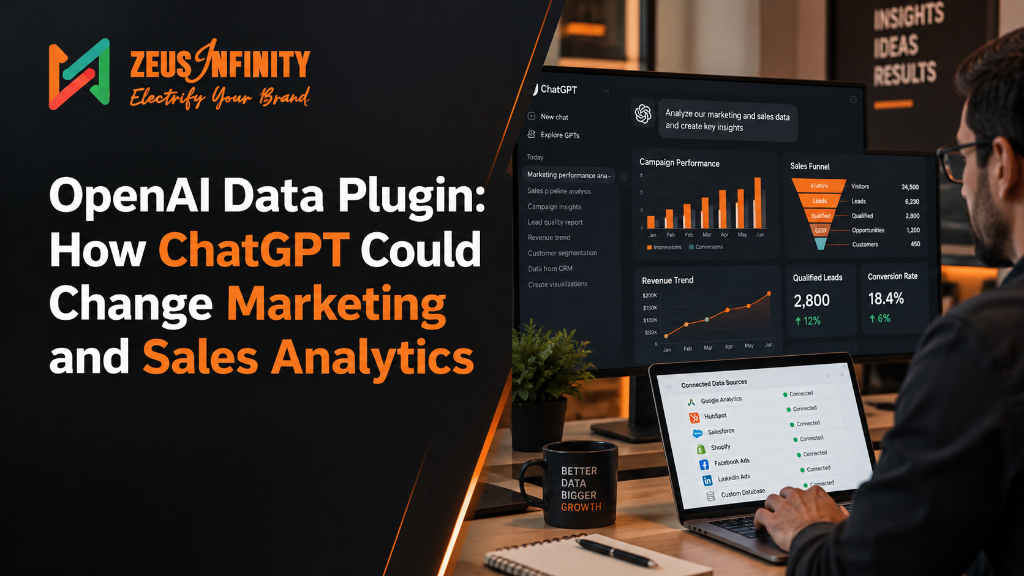
Table of Contents
Marketing and sales teams already collect large amounts of data. The problem is often not having the data, it is finding the right information across different systems and understanding what it means.
Marketing performance may be stored in one platform, customer and lead information in a CRM, sales opportunities in another system, and revenue data elsewhere. When performance changes, answering a simple question such as “Why did revenue fall even though leads increased?” can require several reports, dashboards and people.
OpenAI's new Data plugin for ChatGPT Work and Codex introduces another way to investigate these questions. Instead of only navigating predefined dashboards, businesses can connect approved data sources and investigate their data by asking questions in natural language.
OpenAI introduced the Data plugin on 10 September 2026. It can analyse connected business data, investigate changes, answer follow-up questions, and create interactive dashboards and reports. The important development is therefore not simply that ChatGPT can analyse data. It is that businesses can potentially move from business question → data investigation → explanation → follow-up analysis within the same conversation.
1. What Is the OpenAI Data Plugin?
The Data plugin is designed to help users investigate business questions using company data available through approved connections in ChatGPT Work and Codex.
A user can start with a question such as:
“Compare revenue this quarter with last quarter and explain the largest changes.”
The Data plugin can analyse the relevant connected information and return its findings. The user can then continue the investigation with follow-up questions without starting the analysis again.
• “Which region experienced the largest decline?”
• “Which customer segment contributed most to that decline?”
• “Compare that segment with the previous quarter.”
This creates a conversational method of exploring business data rather than requiring every possible question to have its own predefined report. OpenAI also says the Data plugin can create interactive dashboards and reports, which can be refined and published for others to use.
2. Which Business Data Can the Data Plugin Use?
OpenAI currently lists approved data sources including:
It can also bring files and documents from services such as Google Drive and SharePoint into an analysis when those connections are available.
For non-technical business leaders, these systems can simply be understood as different places where company information is stored. One source may contain sales data. Another may contain customer information. Another may hold internal reports, calculations or business documentation.
The value of connecting these sources is that a business question often cannot be answered by looking at only one dataset. A marketing platform, for example, may tell you how many leads a campaign generated. It may not tell you how many of those leads eventually became paying customers.
Connected Customer Journey:
3. How Could the Data Plugin Change Marketing and Sales Analytics?
Traditional business dashboards are mainly designed to monitor known metrics.
Marketing Dashboard Metrics
- Advertising spend
- Website traffic
- Cost per lead
- Number of leads
- Conversion rate
Sales Dashboard Metrics
- Qualified leads
- Opportunities
- Pipeline value
- Win rate
- Closed revenue
These dashboards remain useful. The Data plugin does not make them unnecessary; OpenAI specifically says Data can work alongside existing business intelligence tools. The difference appears when someone needs to investigate why a number changed.
| Traditional Analytics | Conversational Analysis |
|---|---|
| Start with a dashboard | Start with a business question |
| View predefined metrics | Ask about specific metrics or changes |
| Move between reports to investigate | Continue with follow-up questions |
| Human connects findings across reports | AI assists with analysing connected information |
| Dashboard provides monitoring | Conversation supports investigation |
4. Where Could Marketing Teams Use Conversational Data Analysis?
1. Campaign-to-Revenue Analysis
Marketing teams frequently measure campaign performance using clicks, impressions, conversions or leads. Those numbers do not necessarily show whether the campaign generated revenue.
If the required marketing, CRM and sales data is connected, analysis could go further: Campaign → Leads → Qualified Leads → Opportunities → Customers → Revenue
2. Lead Quality Analysis
Generating more leads does not automatically mean generating better leads. A business may increase lead volume while experiencing lower sales conversion. Analysing marketing and CRM data together could help determine whether the change is associated with a particular acquisition channel, specific campaigns, customer segments, or geographic markets.
3. Sales Funnel Analysis
A sales funnel contains several stages (Lead → Qualified Lead → Opportunity → Proposal → Closed Customer). Conversational analysis could help identify where the largest change occurred and then allow the team to investigate that stage more closely.
4. Customer Segment Analysis
Overall performance numbers can hide important differences between customer groups. Connected analysis can help compare performance by customer type, company size, geography, acquisition source, product, or industry.
5. Recurring Marketing and Sales Reporting
OpenAI says Data can create interactive dashboards and reports from an analysis. Published dashboards can also be kept up to date through cloud automation, standardising recurring analyses for marketing performance, sales pipeline, and revenue trends.
5. AI Still Depends on Good Business Data
Connecting AI to company data does not automatically make the information accurate. One of the most important requirements is having consistent definitions.
Consistent Metric Definitions:
Marketing and sales may both use the term “qualified lead” while defining it differently. Marketing may consider someone qualified after completing a form, while sales may only consider them qualified after an initial call confirming intent. OpenAI addresses this through business definitions (a semantic layer). AI makes analysis faster; it cannot automatically correct inconsistent definitions.
6. How Should Businesses Approach Implementation?
The starting point should not be connecting every available system. Businesses should first identify the questions they repeatedly struggle to answer, working backwards:
The 9-Step Implementation Process:
Business Question → Required Data → Clear Definitions → Connected Systems → AI Investigation → Human Verification → Decision → Action
7. What About Data Access and Permissions?
Business data can contain commercially sensitive information, so access control is important. OpenAI states that queries use the connected account's existing permissions, including applicable table, row and column restrictions. Workspace administrators can also control which connections are available and which users or groups can access them.
8. From Business Reporting to Business Action
The Analytics Progression:
9. How ZI Looks at Conversational Business Analytics
At ZI, we see the value of developments like the OpenAI Data plugin primarily at the workflow level. Adding another AI tool does not solve fragmented marketing or sales operations by itself. The stronger starting point is identifying where information is difficult to access, where teams repeatedly perform manual analysis, and where important business questions require several systems or departments to answer.
For marketing, sales and GTM teams, the opportunity is not simply more AI. It is a shorter and more reliable path from business question to business action.
10. Frequently Asked Questions
What is the OpenAI Data plugin?
The Data plugin helps users analyse connected business data in ChatGPT Work and Codex. It can investigate business questions, explain changes, support follow-up analysis, and create interactive dashboards and reports.
When did OpenAI launch the Data plugin?
OpenAI announced the Data plugin for ChatGPT Work and Codex on 10 September 2026.
Which data sources does the OpenAI Data plugin support?
OpenAI currently identifies approved sources including Amazon Redshift, ClickHouse, Databricks, Google BigQuery, MongoDB and Snowflake. Files and documents from services such as Google Drive and SharePoint can also be brought into an analysis when the relevant connections are available.
Can the Data plugin create dashboards?
Yes. OpenAI says users can create interactive dashboards and reports, refine them through follow-up questions, and publish analyses for others.
Does the OpenAI Data plugin replace BI tools?
Not necessarily. OpenAI says Data integrates with existing BI tools. Dashboards remain useful for monitoring established metrics, while conversational analysis provides another way to investigate questions and changes.
Does ChatGPT automatically understand a company's metrics?
Businesses can provide authoritative metric definitions, calculations and relationships between datasets to improve the analysis. OpenAI recommends verifying the metric definition, source, filters and time period before relying on a result.
Is company data access controlled?
Yes. OpenAI says Data queries use the connected account's existing permissions, including applicable table, row and column restrictions. Workspace administrators can also manage connections and access.
The Bigger Opportunity for Marketing and Sales
The OpenAI Data plugin is significant because it changes how businesses can interact with their information. Instead of relying entirely on predefined dashboards and manually moving between reports, teams can increasingly begin with a business question and investigate the underlying data conversationally.
For marketing and sales teams, this could make it easier to connect activity with outcomes, investigate funnel problems, understand lead quality, compare customer segments and trace marketing performance further towards pipeline and revenue.
That is the shift ZI is watching: from collecting more information to making existing business information easier to understand, investigate and act on.